Reprinted from the original post with permission from La Piana.
Across the nonprofit sector, leaders are confronting an increasingly familiar and exhausting reality: the needs of the communities they serve continue to grow, while the organizational capacity required to meet those needs has been disrupted from nearly every direction. Many leaders have made – and continue to make – tough decisions in response to sudden and significant reductions in funding, federal and state policy changes, or the loss of institutional knowledge due to staff shakeups. Complicating all this is a fierce internal debate at many organizations about whether anything short of a “fight” or “resist” approach represents a betrayal of their mission and values. This moment is intense, but it will not be the last disruption nonprofit leaders face.
What is more troubling than uncertainty itself is how many organizations adopt a “wait and see” approach by default – effectively choosing not to choose a strategy at all. Of course, no one can predict exactly what will come next, but we have a responsibility to the missions we steward to do our best to be prepared. And while the next disruption may not take the form of a financial crash, a pandemic, or a dramatic shift in government priorities, there will be more shocks and surprises ahead.
So how does a leader prepare for this?
Many of the conversations the La Piana team is facilitating with nonprofit leaders reflect this challenge. Organizations are taking a closer look at their programs and initiatives and asking important questions about where to invest, how collaboration might strengthen impact, and where greater focus may be needed. While these questions may feel especially timely now, any organization can benefit from making them part of an ongoing practice of assessment and planning.
We see five strategic options leaders return to again and again, which we refer to as the 5S Decision Lens: stay Steady, Seed new capacity, Shop for it, Share it with others, or Sunset the work.
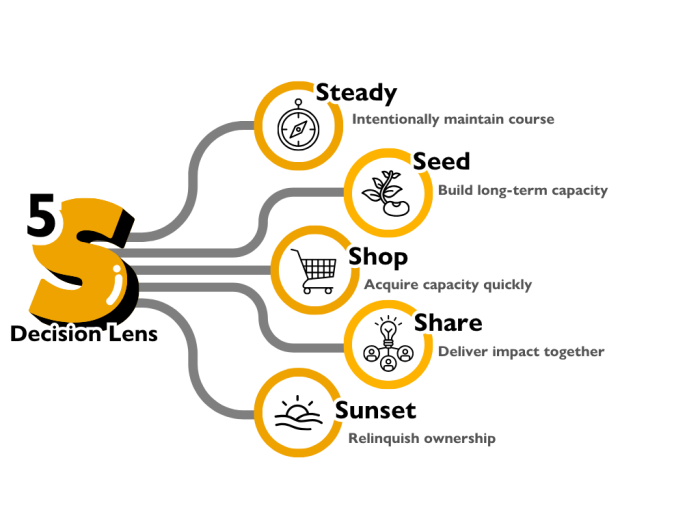
Steady – Intentionally maintain course
For many leaders, a steady hand is exactly what is needed. Their organizations continue to deliver strong mission results and have the capacity to sustain their work under current and anticipated conditions. The key to this approach is that it is a thoughtful, evidence‑based choice to stay the course – not inaction or inertia. Choosing this path requires regular internal assessment to confirm that assumptions still hold and that the work continues to deliver results.
Seed – Build long-term capacity
An option for expanding mission‑aligned work is to invest in building long‑term capacity to sustain and deepen impact over time. This may involve hiring or developing staff; upgrading systems, infrastructure, and processes; creating or redesigning programs; or strengthening governance, management, or operational capacity. This is not a quick process. Organizations choosing this path have the resources and time needed to transform their work for the long haul and strengthen mission sustainability.
Shop – Acquire capacity quickly
When speed matters, leaders may acquire capacity from external sources. Common approaches include contracting with vendors, consultants, or service providers; purchasing tools, platforms, or systems; or hiring experienced staff rather than developing internally. This is not an abdication of responsibility, but a way to rapidly bring capacity in‑house and integrate it so the organization can achieve results more quickly.
Share – Deliver impact together
In many cases, going it alone will not suffice. By combining strengths and sharing responsibility with other organizations, leaders can achieve greater impact together than apart. This approach can take many forms, including program transfers, partnerships and alliances, shared services or joint programs, fiscal sponsorships, or mergers and acquisitions.
Sunset – Relinquish ownership
The default lens at most nonprofits is to find ways to do more to meet the range of needs we see every day. The reality is that sometimes to have greater impact, an organization must do fewer things. Intentionally narrowing scope, handing off responsibility, or stopping work altogether can refocus resources toward the organization’s strengths. This may look like pausing or shrinking programs, spinning off work to another organization, or exiting a geography or initiative. It might also mean dissolving the organization altogether. Central to this approach is viewing the mission as greater than the structure of any individual organization. With that lens and values‑driven planning, these choices can respect and benefit the communities served rather than represent failure.
Put together, the 5S Decision Lens helps leaders quickly sort the full range of strategic options before jumping to solutions:
- One option (Steady) affirms staying the course because it’s working
- Three options (Seed, Shop, and Share) address different ways to add capacity
- One option (Sunset) names what to stop owning so the mission – not the institution – comes first
Together, this lens gives leaders permission to carefully engage their boards, staff, and communities to choose a path forward, rather than defaulting to growth, resistance, or crisis reactions – and instead lead with intention.
Onuka Ibe is Managing Partner at LaPiana Consulting, a national consulting firm that helps social service organizations achieve their increasingly critical missions in a time of monumental and often unpredictable change. Learn more at www.lapiana.org.


